Pages

Friday, June 14, 2013

Two new videos. Hive activity and bait hive/frame construction.

06-08-11

Here's a short video of the activity at the front of our hive and the inside (seen through the observation window) after about one month after installation. They seem to be doing pretty well. They're fairly active today, thankfully, it's been one of the only nice days we've had all spring. It's been pretty rainy and wet here. As you can see they're brining in pollen, which is a very good sign that the queen is laying. You can also see the top box is pretty much 100% full. You can see in the bottom box that they have not yet started building comb in that box. The only thing there is the small bit of comb that I moved down to try and encourage them to start building there. Not sure what else to do to try to get them to move down. If you've got any ideas, leave a comment.


06-11-13

This second video is a little bit longer. In it, I explain how I built two more bait hives. This time the with the correct internal volume! One is made out of two empty Warre boxes that I put a base and lid on and attached together. I forgot to mention in the video that I drilled some holes in the bottom box for the bees to use as an entrance. If I ever need to use that particular box in a hive, I'll just plug the holes with some quark. The second bait hive is made out of scrap wood I got for free from craigslist. I made it with just a skill saw, jig saw, and hand drill to show how easy it can be to build a bee hive. I did use the lath we ripped to size on my dad's table saw, however. So there's still that part that's a bit harder to do. Need to figure out an easy way to make those top bars without any special tools. In this video, I also show how I made some frames and half-frames to fit in a standard, unmodified Warre hive. I made these to use with my widow-less boxes so we can do inspections in them. I also made them to see how they worked in case anyone ever need to have removable frames for a beehive permit or what not. I still like the idea of Warre's system, using minimal intrusion and to simply let the bees be bees and do their thing, but it's nice to experiment and come up with way to let the bees do their thing and still be able to check on them once in a while. If one were to truly do minimally invasing beeking, it might be more like the Japanese system, which is pretty much the same as a Warre hive, but with no top bars at all, just some cross braces to give the honey comb some support and then let the bees make the comb any which way they please. I'm rambling now, though, here's the video.


Monday, June 3, 2013

Inspection 16 days after installation. Probably the last big manipulation for a while.

5-27-13
Well, here's the most intensive hive inspection/maintenance we've performed yet and, quite possibly, the most intensive we'll get all summer. Warre advocated for minimal hive inspection/maintenance, and that's probably what shoot for here on out. Honestly, that's one thing I appreciate about Warre's design. I don't have to constantly be running out to make sure everything is going okay. In fact, as you'll see in this video, we have a bit of cross combing starting in the top box (more on that after the video), but with this design, you really manipulate boxes, not individual combs, so I'm really not going to worry about it that much. Plus, with the observation window built into each box we've made so far, we can at least observe them a little bit that way. It's unlikely we'll move or inspect any more comb until we harvest an entire box at the end of the summer (hopefully!) or next year (more likely).


So, as you can see in the video, there was a bit of cross combing. Here's a picture that shows it in a little more detail. The dashed line is likely the first comb they built and is dead center. Everything to the right and left, as you can see, is shifted toward that bar. There's an empty space on the right that I'm not sure what the bees will do with now and a little bit of cross-combing on the left as you can see in the circle.


Here's some close ups of the cross-combing and the emptey space.


5-29-13
So after the video was taken (on a Monday) I went home and respaced the bars in the box that used to house the jar feeder. I ended up putting nine bars in (which I have seen on some webpages/discussion boards before, see Warre Top Bar Spacing and Bar Spacing on a Warre Hive) because that's what it appears the bees were trying to do. I'll just oblige them, right? Give the bees what they want! I came back on Wednesday, switched out the empty bottom box for the new box with the nine bars, and we'll see what they do now.

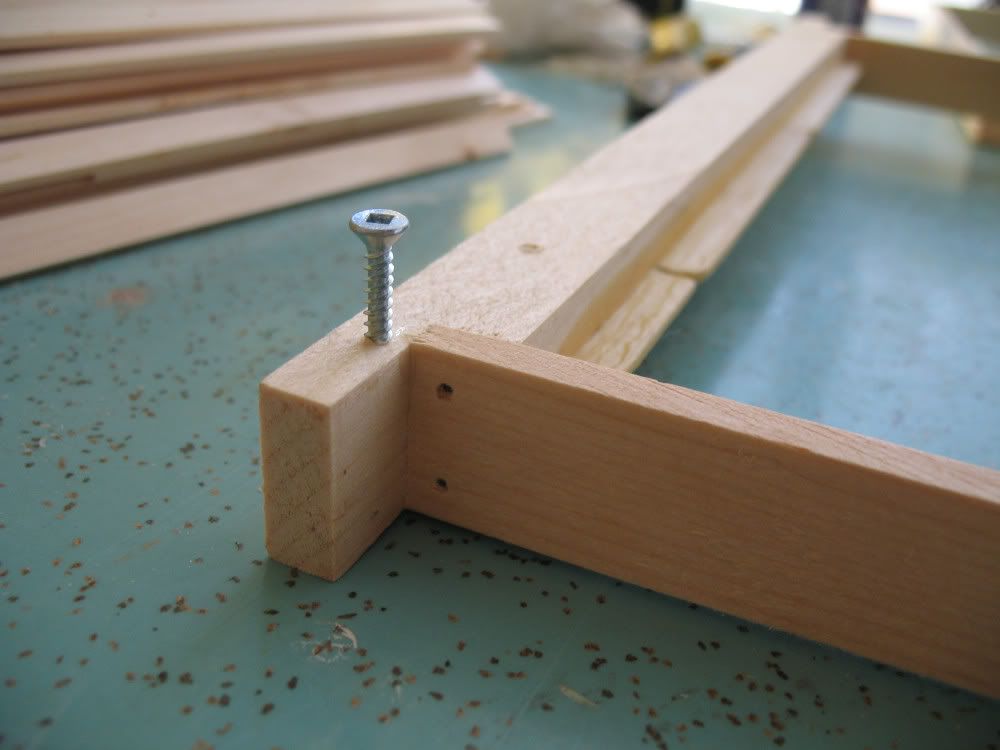
In doing this, I also changed how I had the bars spaced and secured. In the pictures above you can see I used a 1 inch wire nail that, more or less, acts as a pin to keep the bar in place (I drilled the hole it rests in larger than the nail so it just slips in and out). This was rather difficult to measure and drill all the holes, plus you can't change it once it's done, and I've already lost a bunch of nails. While researching the whole Warre bar spacing question, I discovered this amazing blog Bee Crazy which had an ingenious approach to bar spacing. As you can see in the following picture, Sam just screwed a small spacer screw to the side of each top bar. By screwing them futher in or out, you can adjust the distance between the bars. Brilliant! Oh, and FYI, Sam is in Canada and has used Kenyan Top Bar Hives and now Warre Hives. Yay for more information on keeping top bar bees in cold climates!

Saturday, May 25, 2013

Solitary bees in my flower garden

As you may know from reading my very first blog post, or from the "About Us" page on the blog, I don't keep my honey bees at my home, but at my father's. One of the reasons we decided to do this was because of the restrictive regulations on keeping beehives in the city. I may cross that bridge eventually, but not right now.

Well, bees will be bees, and they'll go wherever there are flowers to collect nectar and pollen from, regardless of whether or not city officials and neighbors want them. Yesterday while I was weeding our front flower garden and putting down wood chips, I ran into 4-5 of these little buggers flying around...


Some quick online research revealed that these are Andrenid Bees. They are small, native, solitary bees that build nests in a small, pencil sized hole they dig in the ground. Here's some info:
UMN - Solitary Bees with a Twist
UMN - Andrenid Bees

I've known about solitary bees before. In fact, I remember some bees digging tunnels in the sandbox at my parents' house when I was a kid. I've also known that you can build houses for various types of solitary bees, but never did much research. So I did a little last night. It seems that many of these native bees are even more prolific pollinators than honey bees! Plus their homes are super easy to build, inconspicuous, and probably wouldn't bother the neighbors in the city too much. Maybe I'll take up a project soon and build a house for some bees here. Then I can be a city beekeeper as well!

Bumble Bee Homes
How to make a bumble bee nest
Providing bumble bee nest sites
Plans for building bumble bee nest boxes


Orchard Mason Bee Homes
How to build a bee house
How to construct a sturdy, all wood mason bee house
Bring on the bees

Thursday, May 23, 2013

More on making a bait hive from our extra Warre box

I've got some pictures of the construction of our bait hive a few posts back. Here's a video talking about preparing the hive to put out and using our beeswax "polish" to seal/waterproof the outside of the hive.


Busy as a bee - One week after installing our bee package into our Warre hive 05-18-13

Whoever coined the phrase "busy as a bee" was NOT joking. Check out everything they've accomplished in just one week. Keep in mind this is in Minnesota, spring arrived late (there was snow on the ground less than one week before we installed the bees), there has been rain for about 2-3 of the 7 days they've been in the hive so I don't know how much foraging they've been able to do, and this is a 2lb package of bees instead of the 3lb package I was expecting. Crazy...