5-27-13
Well, here's the most intensive hive inspection/maintenance we've performed yet and, quite possibly, the most intensive we'll get all summer. Warre advocated for minimal hive inspection/maintenance, and that's probably what shoot for here on out. Honestly, that's one thing I appreciate about Warre's design. I don't have to constantly be running out to make sure everything is going okay. In fact, as you'll see in this video, we have a bit of cross combing starting in the top box (more on that after the video), but with this design, you really manipulate boxes, not individual combs, so I'm really not going to worry about it that much. Plus, with the observation window built into each box we've made so far, we can at least observe them a little bit that way. It's unlikely we'll move or inspect any more comb until we harvest an entire box at the end of the summer (hopefully!) or next year (more likely).
So, as you can see in the video, there was a bit of cross combing. Here's a picture that shows it in a little more detail. The dashed line is likely the first comb they built and is dead center. Everything to the right and left, as you can see, is shifted toward that bar. There's an empty space on the right that I'm not sure what the bees will do with now and a little bit of cross-combing on the left as you can see in the circle.
Here's some close ups of the cross-combing and the emptey space.
5-29-13
So after the video was taken (on a Monday) I went home and respaced the bars in the box that used to house the jar feeder. I ended up putting nine bars in (which I have seen on some webpages/discussion boards before, see
Warre Top Bar Spacing and
Bar Spacing on a Warre Hive) because that's what it appears the bees were trying to do. I'll just oblige them, right? Give the bees what they want! I came back on Wednesday, switched out the empty bottom box for the new box with the nine bars, and we'll see what they do now.
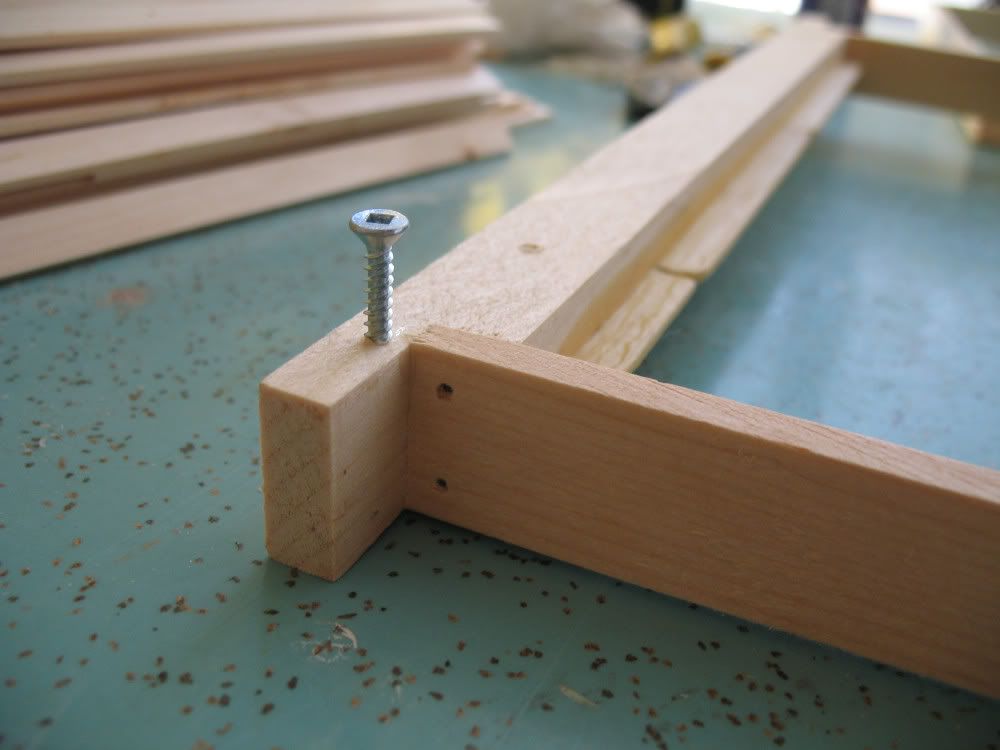
In doing this, I also changed how I had the bars spaced and secured. In the pictures above you can see I used a 1 inch wire nail that, more or less, acts as a pin to keep the bar in place (I drilled the hole it rests in larger than the nail so it just slips in and out). This was rather difficult to measure and drill all the holes, plus you can't change it once it's done, and I've already lost a bunch of nails. While researching the whole Warre bar spacing question, I discovered this amazing blog
Bee Crazy which had an ingenious approach to bar spacing. As you can see in the following picture, Sam just screwed a small spacer screw to the side of each top bar. By screwing them futher in or out, you can adjust the distance between the bars. Brilliant! Oh, and FYI, Sam is in Canada and has used Kenyan Top Bar Hives and now Warre Hives. Yay for more information on keeping top bar bees in cold climates!